

The post-pandemic reshuffle of how we work has permanently altered the typical working day.
Hybrid teams are now the norm, and budgets are under strain with owners needing a space that enables in-person workdays for their hybrid teams without them being locked into private, expensive office contracts.
The dilemma is that while private office spaces provide greater control and privacy, the flexibility of coworking often makes them a more cost-effective alternative, especially for newer businesses that don’t have lots of money in the bank.
This practical guide on how to best choose offices or coworking spaces covers several important questions and factors that you need to consider when deciding which space is best for you.
By the end of this, you’ll know which options are best for your team.
Traditional offices vs coworking: What’s the difference?
Office spaces offer businesses a place to call home. They have their own four walls and a space that they can tailor exactly how they want.
And while many companies like the idea of designing their own office, the associated costs of a fit-out and set up of vital infrastructure like wifi, utilities, and furniture turn it into a five or even six-figure investment.
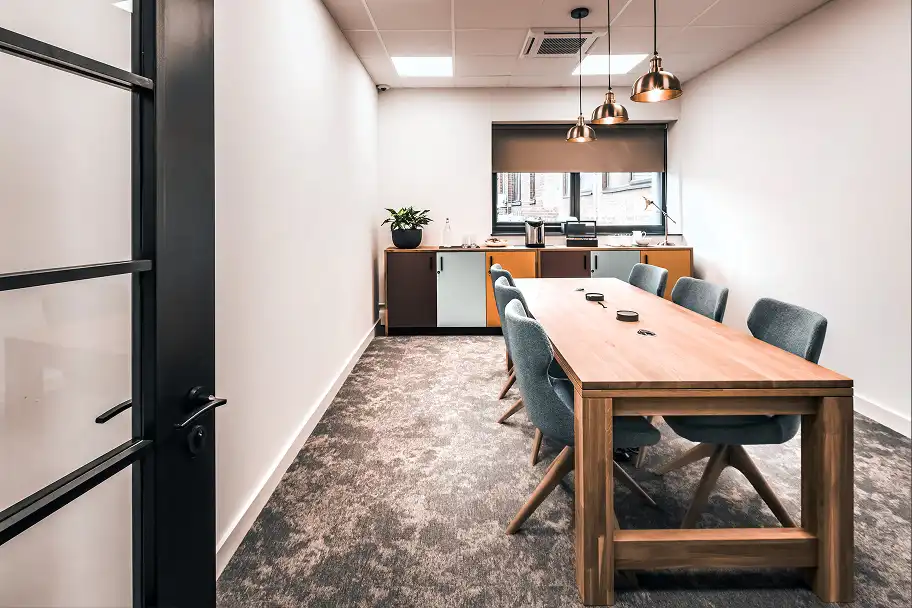
Coworking spaces, on the other hand, offer businesses everything they need from a traditional office space, including private meeting rooms and places for hybrid teams to work together in a far more affordable package, with only a few small sacrifices needed to benefit from it.
Sacrifices like a reduction in privacy and the space feeling less like ‘yours’. However, both of these can be bypassed with private meeting rooms and A/V equipment, which can show off your brand to clients.
The huge investment in utilities that we mentioned above is removed when opting for a coworking space, with everything instead being bundled into one monthly payment.
5 Key factors to weigh up
1) Total cost of ownership
The costs of traditional offices don’t just come from the space itself but from all the things needed for them to operate in the way a business wants them to. Some of these costs can dramatically swing as your business expands and usage increases.
On the other hand, coworking spaces are paid for with one predictable monthly fee that bundles in all the essentials needed to work. The upfront cost is dramatically smaller compared to an office space, and it can be easier for businesses to hire more staff without having to pay more.
Places such as The Causeway have parking and on-site support to reduce hidden costs like travel time and IT call-outs, too.
2) Flexibility & scalability
Long leases associated with traditional office space are great when staff numbers are stable and the layout is made for you, but if your hiring plans are up in the air or your growth is dependent on client wins, these 3-5 year leases quickly become a costly burden.
The flexible terms that coworking space offices remove all that risk and uncertainty. Businesses can simply increase or decrease the number of desks they need or move to a private office within the same space if they need to hire.
3) Choice of amenities
Businesses get to choose their IT infrastructure, kitchen features, and broader utilities in an office, which is great if quality control is important. But, they also have to manage them. If things go wrong, it’s on them and their cash reserves to fix it.
A coworking space is all set up and ready to go, in contrast. High-speed internet, meeting rooms and event spaces, and a manned reception team are all ready and waiting to be used by your business. In places such as The Causeway there are also showers, perfect for those who like to cycle in!
To make an informed decision, evaluate what amenities are important to you and decide how important control of them is for your business’s reputation.
4) Location, location, location
Short, convenient commutes keep team morale up and encourage their attendance, so check for parking facilities and nearby public transport when viewing coworking spaces. Hybrid teams are often working in different cities, so choosing somewhere in the middle can help make it as easy as possible for staff to get together.
Existing and potential clients, as well as teams, benefit from being close to you. Having a space close by shortens sales cycles and allows for ad hoc meetings or support to take place quickly.
The Causeway is based in Warrington, which is as close to Liverpool as it is Manchester, making it great for team meetups or client pitches.
5) Culture & community
Traditional office spaces can be good places to form great company culture, but it does rely on hiring the right people to create it.
However, by working alongside people outside your organisation, new businesses can grow their network through chance introductions and by going to social events.
While businesses that value privacy may think coworking isn’t for them, places such as The Causeway offer private, dedicated office space (which doesn’t require an expensive fit-out) within a coworking environment to blend privacy with community access.
Compare a private office and coworking space side by side.
Pros and cons at a glance
| Pros | Cons | |
|---|---|---|
| Traditional office | Greater control of layout, branding, and access to security.A quiet environment with familiar faces suited for focused/confidential work.A strong client-facing impression. | Potentially massive, five or six-figure upfront costs and long commitments.Harder to expand office space as headcount increases or to justify it at all if headcount/daily usage is low.You have to manage suppliers, maintenance issues, and any upgrades to infrastructure. |
| Coworking space | Low upfront costs followed by predictable monthly fees.Very easy to scale usage up or down depending on projects and needs.Access to high-grade amenities and a professional network full of like-minded, driven individuals and businesses. | Unable to customise the wider coworking environment.Some shared areas can be busier during peak times.The team identity isn’t as tied to a physical location, so it needs to be nurtured in other ways. |
Three reasons you might want to consider coworking for your business
When choosing between an office and coworking space, owners of more traditional businesses may think these collaborative areas are only for young, dynamic SMEs and freelancers. However, there are plenty of reasons and real-world scenarios that prove coworking is for almost all businesses, and there is growing evidence of the benefits of coworking spaces for SMEs and start-ups. Here are some examples:
A growing consultancy business
A 10-strong firm may start using dedicated desks for a period before moving into a 12-person office within the same coworking space and add four hot desks for contractors or members who have a hybrid working arrangement. In no time at all, this business has increased headcount without changing addresses or increasing downtime.
Regulated services firm
This business handles confidential client data, so it opts for a private office that has controlled access. They do, however, use shared meeting rooms with secure screen-sharing when required, all while enjoying a dedicated reception team and parking for visitors.
Hybrid tech start-up
A business such as this may have one private suite as its base to carry out interviews or meetings and then bolt on six coworking passes for the team to use when they’re not working from home. This cost is flexible and can change based on project cycles.
Questions to ask on a tour
To help you assess any potential coworking space, we’ve put together a list of questions that you can ask so that you feel happy that the place you choose is right for your business.
Cost
- What’s included in the monthly fee?
- Are there caps on meeting room hours?
- Is printing, mail handling, and parking included?
Flexibility
- What are the minimum usage terms?
- Is there an easy path to move from a hot desk to a private office?
- Can you add desks in the middle of the month?
IT and security
- Is there an after-hours entry?
- Are VLANs available within the wifi network?
- How can people access the building?
Noise and focus
- Are there dedicated quiet zones?
- What is the booking policy for meeting rooms?
- What are the peak time patterns?
Community
- Is there an events calendar?
- What’s the member mix in terms of industries and company sizes?
- Do you have any examples of businesses that have successfully collaborated because they’ve met here?
Come and see if coworking is right for you
Choosing between a coworking space and an office space is about weighing up your priorities as a business. Namely, things like control, flexibility, and privacy.
Remember, the main appeal of a coworking space is its flexibility. There’s no need to go all in with it on day one. You can start small and then increase usage to help you achieve your next business milestone.
To really understand if a coworking space is right for you, it’s best to come and view and use one during a typical workday to see how the atmosphere and way of working match your business.
Book a tour
Drop in for a tour.
You never know, your next workplace could be closer than you think!